
I was on my way home from Millsboro after a doctor’s appointment this morning. As I came North on 113, suddenly the sign announced, “Stockley Center” with an arrow pointing right. It would be hard to adequately articulate the memories crashing around my head and heart at the sight of that sign.
For over 35 years, Stockley Center was a familiar institution to me as I provided care for disabled adults. I took my initial training there in 1984-85. Training sessions, educational meetings, paperwork drop off, Dental appointments for my individuals, first aid and medication classes, etc. were common. In the last 15 years of my tenure, when I went to the Center for other required classes or meetings, I would drive back
the long, long lane to The Cemetery where we laid our beloved Gertrude’s body to rest in November of 2005. At first I went often. I would stand at the stone that marked her grave and sing to her.
“Knowing you’ll be there.” “Jesus loves me.” “Suppertime.” “Sojourner’s Song.” She would sing along with me during her years at our house. She had perfect pitch, knew the melodies of almost all the old hymns, even though the words were all jumbled up.
I would often shed tears at that Holy spot, remembering that my Daddy did the graveside Service for her and a short seven weeks later, on a cold December day, we covered his grave in another cemetery beside the church where much of his life history resided.
I don’t think I have been to Gertrude’s grave since Covid, but I made a quick decision and made a quick turn into the road leading to the grounds that were once so familiar to me. There is a new guard house at the entrance where everyone has to stop, and two friendly looking black guards were on duty.
“Good morning,” I say, and smile. They return the greeting cheerfully, and I say, “I’m just on my way back to the cemetery.” Their faces are immediately soberly compassionate, and they nod. “Do I need to do anything? Do you need my name or anything?”
“No, nothing,” they say, almost in unison. “You are free to go.”
I head back the long road and around the corner and head back another long, long road. There have been so many changes to this place since Gertrude and her two brothers, were brought here in 1932. (Thank God)! There have been so many in just the last five years that it blows my mind. Even the cemetery has changed. There is an adequate parking place, and the western part of it has become a veteran’s cemetery. On this eastern side, there are probably a hundred graves of indigent disabled persons who died in state custody. One of them was our Gertrude.
She hated Stockley Center. In those early years, whenever we would travel down 113 to “The Colony,” (as she always called it) she was usually fine until she caught sight of the water tower and she would immediately become agitated and fearful. My heart ached for her. She had suffered much there, and for most of her life, all decisions were made for her. Daniel and I had tried to start a fund for her burial so she wouldn’t have to be buried at Stockley, but it seemed futile. In the end, all that was available to her was a pauper’s grave. She did not have a pauper’s funeral, though. The undertaker said, “I don’t know if I’ve ever seen anything like this. You cannot imagine how often in this place, it is a graveside service with a preacher and me and no one else.” The chapel on the grounds of Stockley Center was packed out, and our family and our church planned a funeral for her that was full of love and memories and laughter and song. Some of her natural family, case managers, supervisors, nurses and aides joined us. There were printed programs with her picture on the front, and she would have loved it. Our church planned a meal afterwards, served in the basement of the church where she often went during her 19 years in our home. It was comforting and affirming.
In the months following her funeral, I often felt sad to think that on the resurrection morning, Gertrude would find herself rising from the ground of the place she hated so much. It just didn’t seem right or fair. It felt like one more injustice to this incredibly sweet songbird who loved Jesus, babies and Santa Claus and the Easter Bunny. And she loved our family . . . But as time went on, my thinking got itself “righted” again, and I thought about the fact that not only will it not matter then, it doesn’t matter now. The first thing she will see on that resurrection morning will be Jesus, and everything will be good.
I looked out across the graveyard as I came through the entrance and was startled to find a flat field. All the tombstones had been lowered into the ground so that a mower could pass over the field without weed eating around the stones. I hated it. Certain Man said that is the way it has always been Maybe. But the ground was still not gobbling the markers up like it is now.
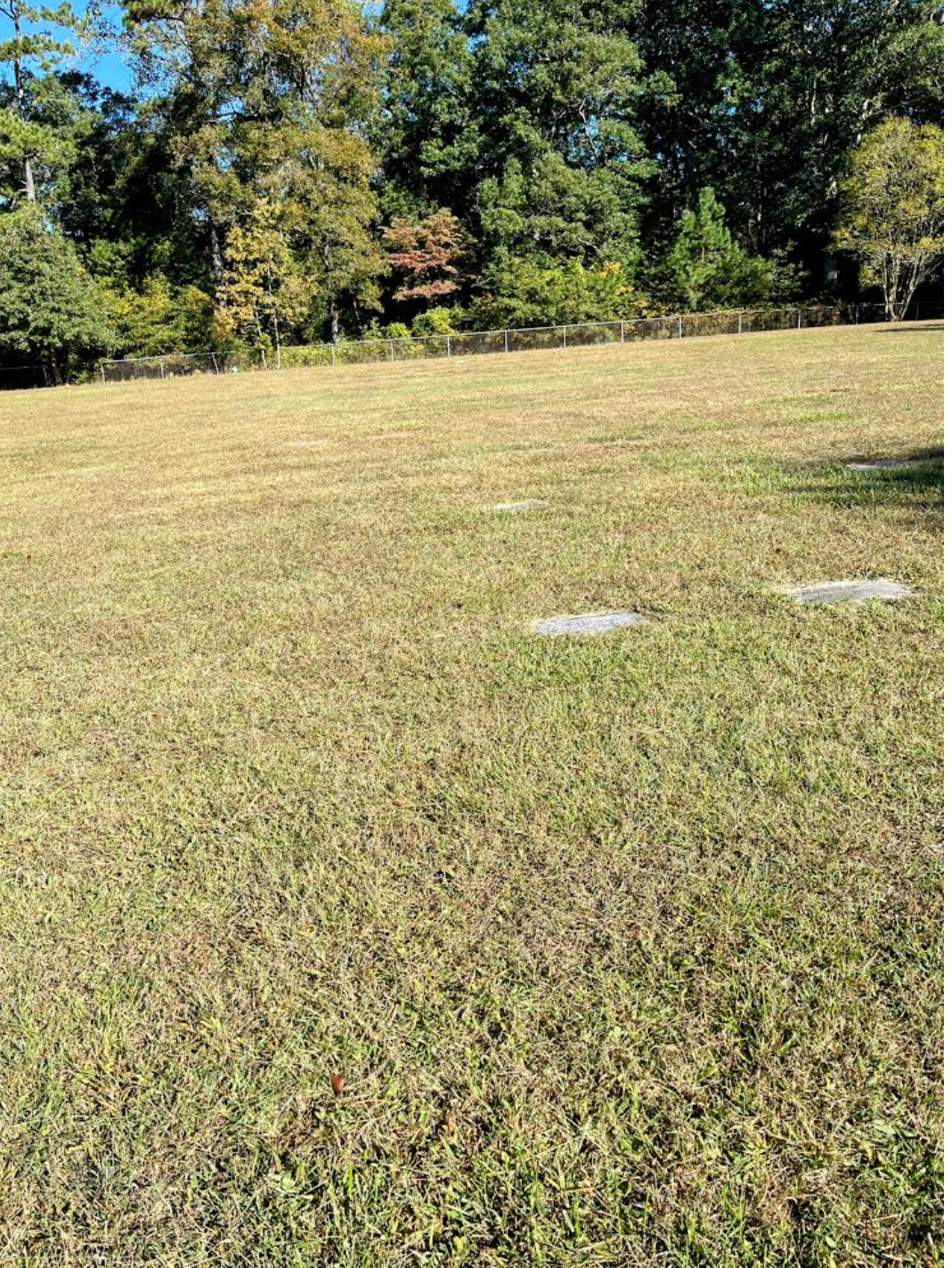
I searched for Gertrude’s grave and finally found it. I am not sure that it is where it was, but the familiar marker was there, and I decided that I would never know for sure.
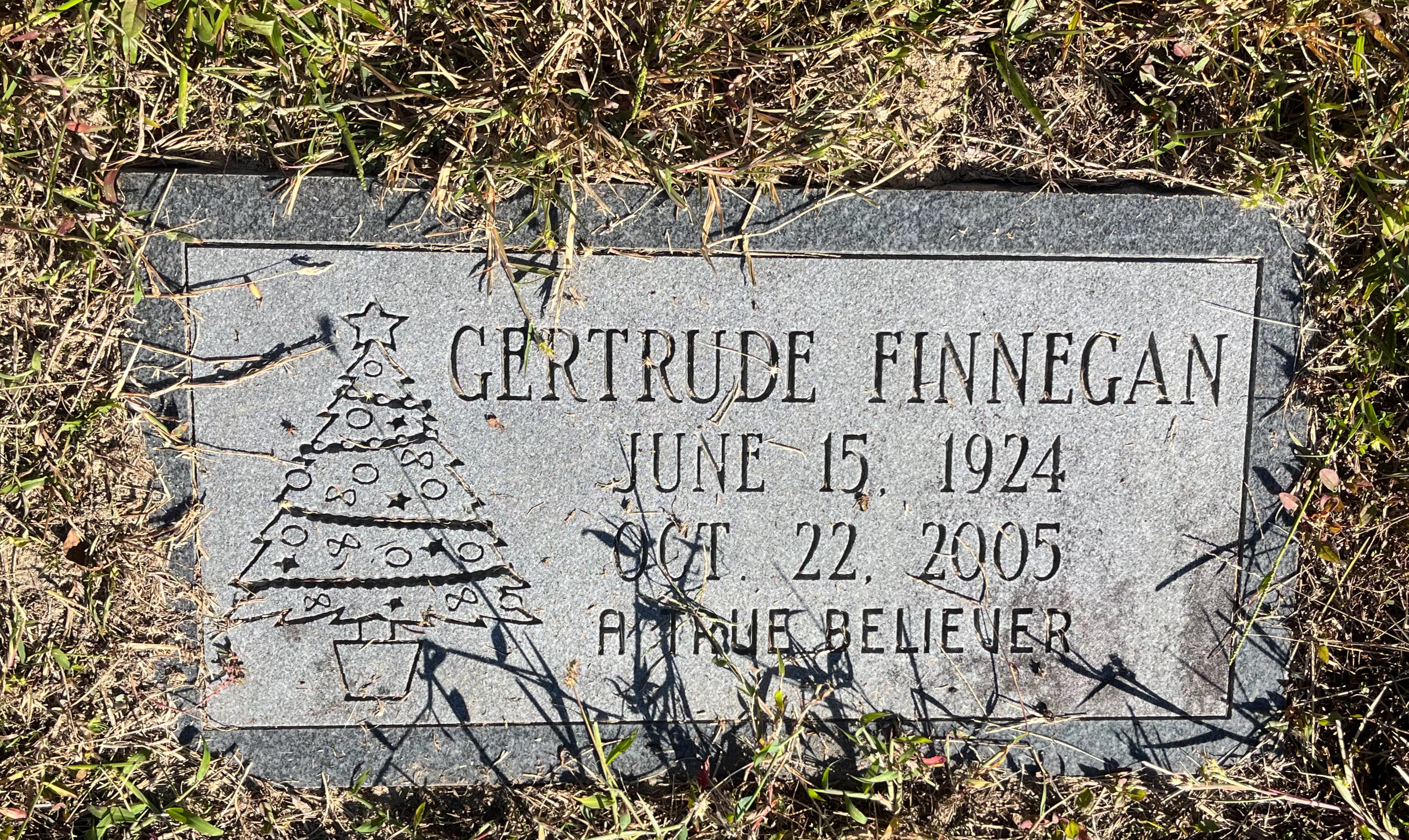
I stood for a while, thinking about all the years, about this precious lady whose mannerisms, peculiar sayings and actions are a part of our family to this day. I felt something prickling my leg and I looked down and there were sand burrs firmly attached to my stockings. I thought about things that prick and irritate and wondered at the prolific crop of these tiny burrs that attach and try their best to get a ride out of where they grew. I picked them off, and they pricked my fingers and held on until I managed to dislodge them. They hurt! But then, so did my heart in this October cemetery on a perfectly glorious day. So many heavies right now, but so much hope. I decided to look around, trace the names of people who we gave respite care to, and who had homes with friends. I was astounded to realize that in this particular section, the graves stopped abruptly around 2012. I saw that there were some that were recent in a small section between the veterans and the Stockley Center Cemetery. Curious, I walked over to check it out. I thought my heart would break. Apparently this is the cemetery of the babies of documented immigrants. Baby after baby, most with merely a small marker and name, some with the name bleached off by the sun, and a very few with a stone. Like this:

The one matchbox car was lying off to the side. I picked it up and thought about a Mama, far from home and family, afraid to seek adequate pre-natal care, who loved and lost and buried here, in an indigent cemetery, a part of her heart. Yet another injustice in our current world.
I traipsed back to my car, started it and made the trip back to the entrance. At the end of the first stretch, as I made the corner, the tears came, hot but sweet and releasing. I wound my way up to the exit, and didn’t need to stop. The window on the exit side of the Guard house was darkened and shut. It was a relief. I gave a perfunctory wave at the window as I went by, and then I was on my way home.
It has been a week of miracles for this Delaware Grammy. There have been moments of “reluctant obedience” that have resulted in affirmation and peace. I’ve been so blessed with warm memories, happy moments, people who love me, and hope for the tomorrow that awaits people I love. I do not always like the diagnosis. I sometimes chafe under the circumstances. And I am not always satisfied with outcomes. But I have a promise from Jesus that I cling to and He has never failed me yet. He never will.
“Lo, I am with you always, even unto the end of the age.”
“He has said, “I will never leave you nor forsake you.”
I do not need to be afraid, grief-stricken of discouraged.
And my heart gives grateful praise.


 Delaware Grammy
You’re an inspiration Marianne!🙏🏻❣️